California behavioral health providers have lived through several years of change: CalAIM, payment reform and new medical necessity criteria. The next 12 months bring three more shifts that land directly on the revenue cycle.
Change 1: One Integrated County Behavioral Health Plan by January 2027
Today, Medi-Cal Specialty Mental Health Services and substance use disorder treatment are usually run through separate county structures. The Department of Health Care Services (DHCS) is requiring every county to combine them into one integrated specialty behavioral health program by January 1, 2027, under a single integrated DHCS-county contract.
For providers, that can mean new contracts, new network certification and quality review processes, and new billing and documentation requirements, especially for organizations that deliver both mental health and SUD services.

Change 2: The Behavioral Health Services Act Replaces the MHSA
Proposition 1 replaced the Mental Health Services Act with the Behavioral Health Services Act (BHSA), effective July 1, 2026. BHSA changes how county funds are allocated, adds substance use disorder services and puts more emphasis on housing and full service partnerships.
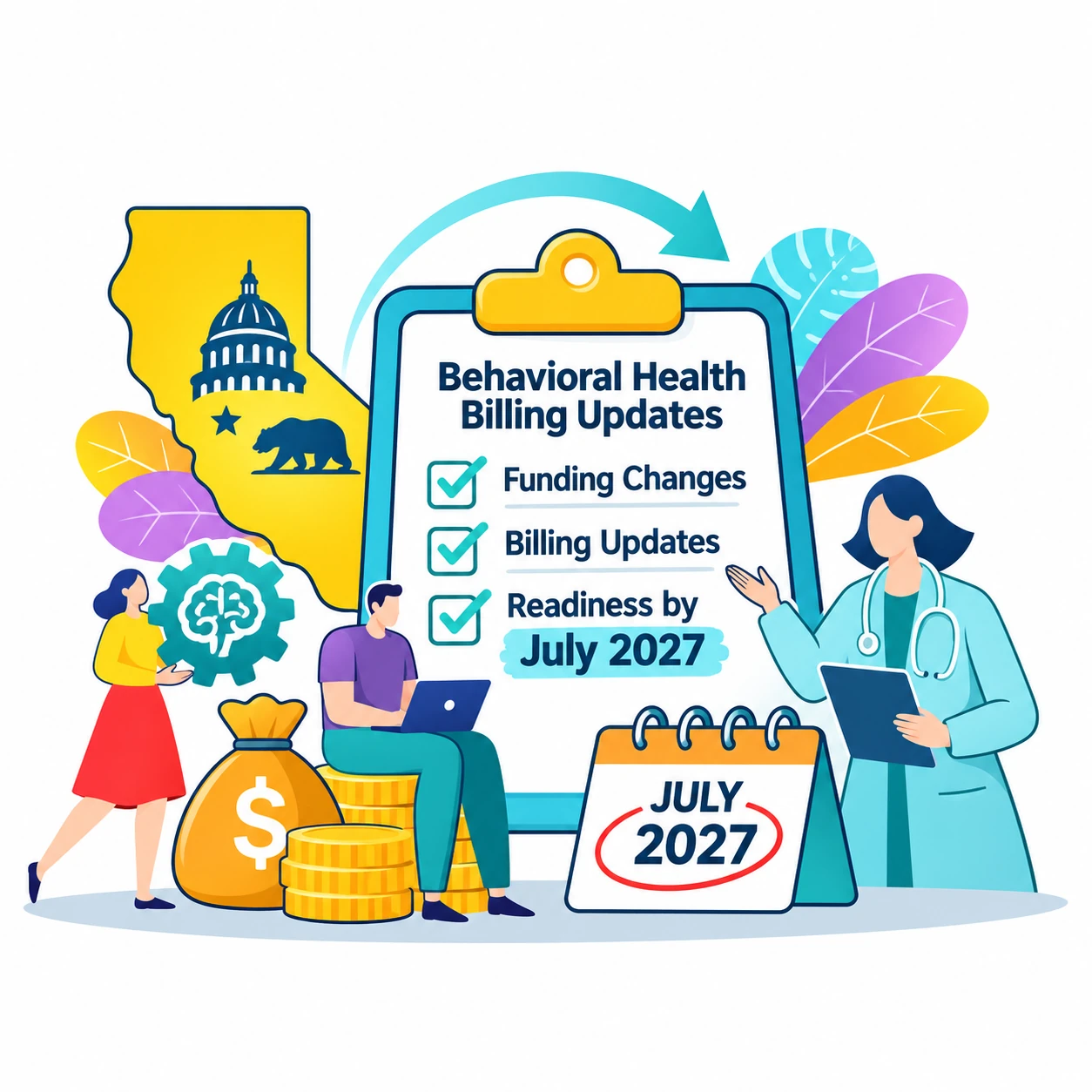
It also raises expectations for billing. Counties are expected to draw down Medi-Cal and pursue other coverage before using BHSA dollars. DHCS guidance indicates providers funded with BHSA dollars will need to be contracted for Medi-Cal, and county-provider contract language expects providers to coordinate with commercial health plans, including billing and prior authorization, starting July 1, 2027.
Change 3: Payment Reform Keeps Raising the Bar
Since July 2023, behavioral health payment reform has moved counties from cost-based reimbursement to fee-for-service rates tied to CPT and HCPCS codes. Counties continue to update rate schedules each fiscal year. In this system, every service must be coded, documented and claimed correctly, because there is no year-end cost settlement to make up the difference. Coding now decides revenue.

What Providers Should Do Now
| Deadline | Action |
|---|---|
| Now | Confirm your county's integration timeline and any new contract, certification or claiming requirements |
| Before January 2027 | Update billing setup for the integrated plan: payer IDs, rate schedules, authorization rules and claim formats |
| Before July 2027 | Build commercial insurance billing: eligibility checks, credentialing with commercial plans and prior authorization workflows |
| Ongoing | Audit CPT coding and documentation against county rate schedules every quarter |
Commercial billing is the biggest new muscle
Many county-funded programs have never billed commercial insurance at scale. Doing it well requires clinicians credentialed with commercial plans, eligibility checks for every client, authorization tracking and a denial management process that understands commercial payer rules. Organizations that start now will be ready when the July 2027 expectations take effect.
Where Symed Fits
Symed, the Behavioral Health Division of Cosentus, runs on Smart RCM: Cosentus experts and Zeus Health, a Cosentus Division, working as one team. Zeus Health checks every claim before it goes out, and named expert teams handle every eligibility gap, authorization, denial and appeal. One partner covers billing, coding, eligibility, claims and even the EHR (optional), among other services, so no claim falls between vendors. Zeus Health runs nearly $1 Billion in claims annually, and Cosentus has served physicians since 1999.
One community behavioral care provider grew revenue 8x, from $1.2M in 2022 to a projected $10M in 2025. Individual results vary.
FAQs
The Bottom Line
California is asking behavioral health providers to bill like health care organizations: integrated, code-based and multi-payer. Providers that build those capabilities in 2026 will turn the changes into steadier revenue in 2027.
Find out what your county billing is leaving unpaid. Know your numbers before you switch billing partners. Start with the No-Cost Financial MRI (Valued at $10,000): Symed checks every claim against the five reasons payers say no, and you keep a dollars-by-reason report and a 90-day action plan.