

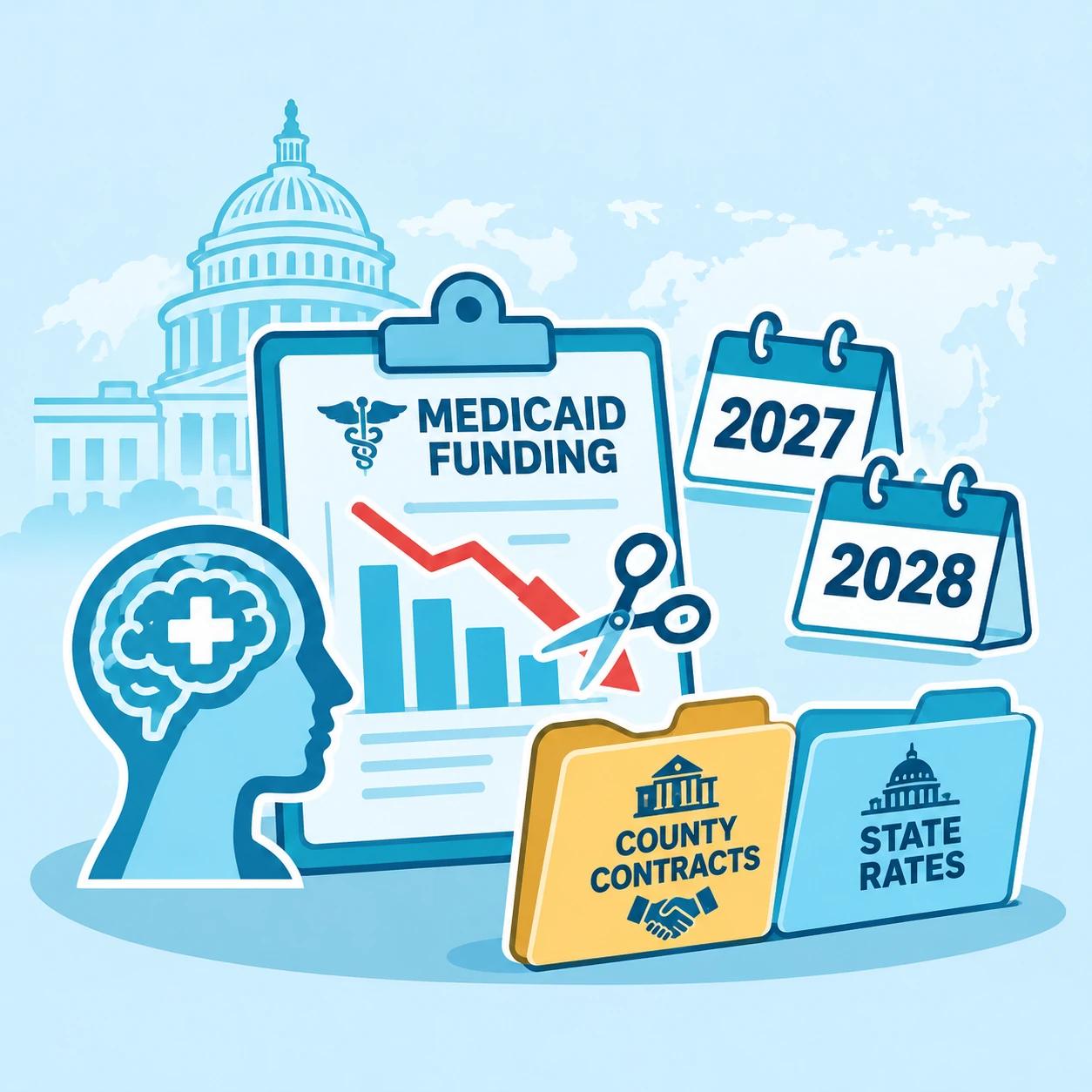
Americans spend $107 billion a year on outpatient mental health and addiction care (JAMA Psychiatry, 2026), and Medicaid pays for much of the care community agencies deliver. Most behavioral health providers will not feel federal Medicaid changes as a single cut. They will feel them through fewer covered patients, tighter state budgets, slower county contracts and flat or lower rates. For CFOs, 2027 and 2028 are the years to plan for.
What Is Changing in Medicaid Financing
The 2025 federal budget law (Public Law 119-21) reduces federal Medicaid spending over the next decade. The Congressional Budget Office estimated federal Medicaid spending will fall by roughly $900 billion over ten years and that millions more people will be uninsured. Key provisions for behavioral health include:
| Provision | Timing | Why it matters to BH providers |
|---|---|---|
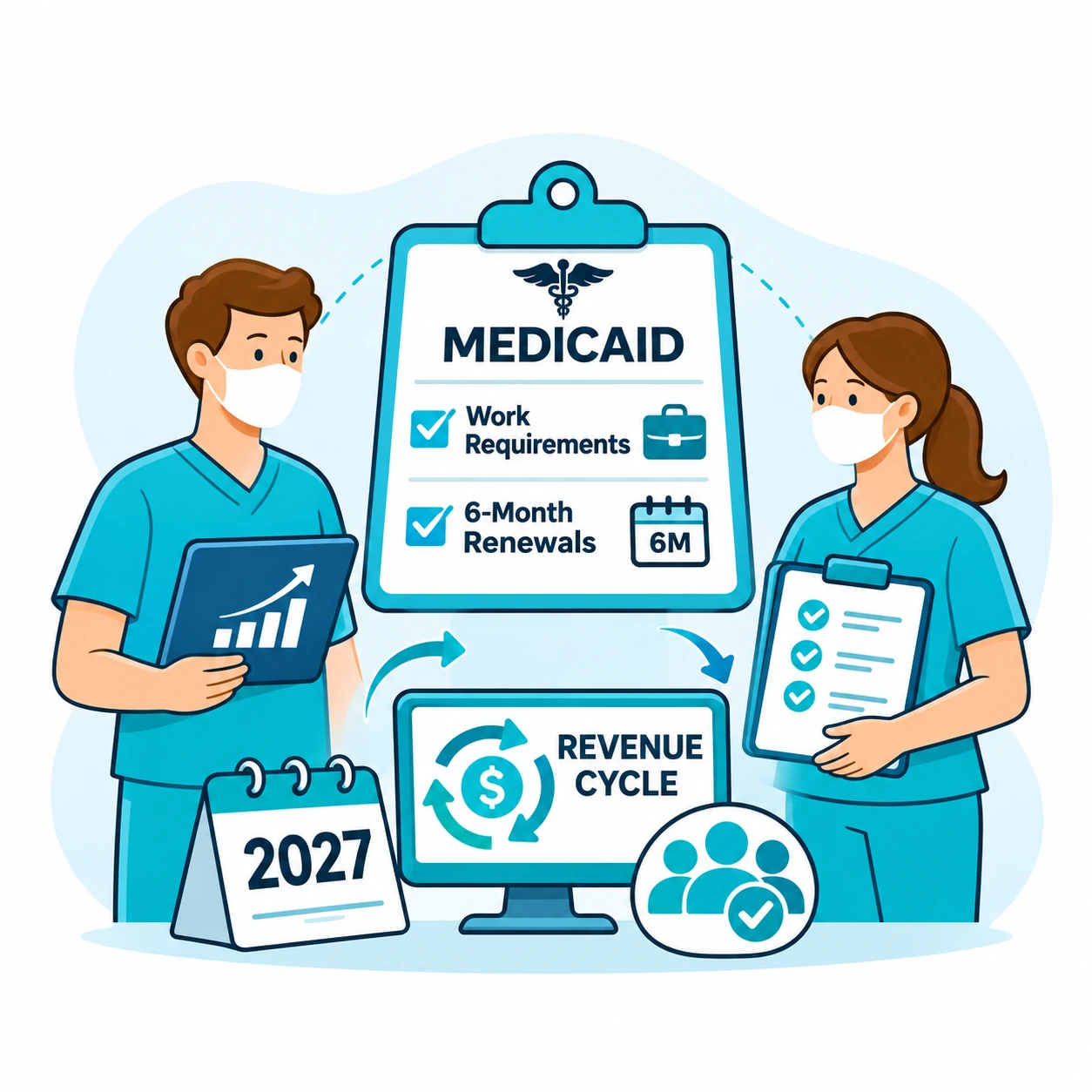
| Work requirements and 6-month renewals | 2027 | Fewer continuously covered patients |
| Shorter retroactive coverage | January 2027 | More uncompensated crisis and residential care |
| Limits on state provider taxes, phasing down for expansion states | Starting FY 2028 | Less state money to fund Medicaid rates and programs |
| Caps on state directed payments | Phased in | Pressure on supplemental payments |
| Cost sharing for some expansion adults | October 2028 | More patient balances to collect |
How It Reaches Your Organization
State budgets: as federal funding tightens, states look for savings in rates, benefits and optional programs.
County contracts: counties pass budget pressure through to providers with delayed contracts, capped allocations or stricter performance terms.
Payer mix: patients who lose Medicaid may become uninsured or move to marketplace coverage, where higher deductibles create patient balances.
Grants: federal grant programs have become less predictable, so grant-funded services need a billing backup plan.

A CFO Planning Checklist
Model three scenarios
Build base, moderate and severe scenarios for 2027 and 2028 covering Medicaid enrollment loss, rate changes and county contract delays. Tie each scenario to a cash runway and a list of decisions you would make.

Collect everything you already earn
Reduce days in A/R and clear aged claims before budgets tighten.
Fix the top denial reasons, especially eligibility and authorization denials.
Make sure every service is coded and claimed under current county and Medi-Cal rate schedules.
Diversify revenue
Bill Medicare for eligible services. Licensed marriage and family therapists and mental health counselors have been able to enroll in Medicare since 2024.
Build commercial insurance billing and credentialing.
Review collaborative care, peer support and care management codes you may not be billing.
Strengthen your case with payers and counties
Organizations that can show clean data on cost per service, outcomes, denials and access are in a stronger position when counties and plans decide where limited dollars go.
Where Symed Fits
Symed, the Behavioral Health Division of Cosentus, runs on Smart RCM: Cosentus experts and Zeus Health, a Cosentus Division, working as one team. Zeus Health checks every claim before it goes out, and named expert teams handle every eligibility gap, authorization, denial and appeal. One partner covers billing, coding, eligibility, claims and even the EHR (optional), among other services, so no claim falls between vendors. Zeus Health runs nearly $1 Billion in claims annually, and Cosentus has served physicians since 1999.
One community behavioral care provider grew revenue 8x, from $1.2M in 2022 to a projected $10M in 2025. Individual results vary.
FAQs
The Bottom Line
Federal Medicaid changes will reach behavioral health providers slowly and then all at once. Organizations that tighten collections, diversify payers and plan for multiple scenarios now will have the cash and the data to keep serving their communities.
Find out how much revenue your agency can protect before 2027. Know your numbers before you switch billing partners. Start with the No-Cost Financial MRI (Valued at $10,000): Symed checks every claim against the five reasons payers say no, and you keep a dollars-by-reason report and a 90-day action plan.


Sources
- KFFAllocating CBO's estimates of federal Medicaid spending reductions across the states: enacted reconciliation packagekff.org
- Commonwealth FundHow new limits on state provider taxes will affect Medicaid fundingcommonwealthfund.org
- JAMA Psychiatry (2026)$107 billion a year on outpatient mental health and addiction care
- CMSMedicare enrollment for marriage and family therapists and mental health counselorscms.gov