

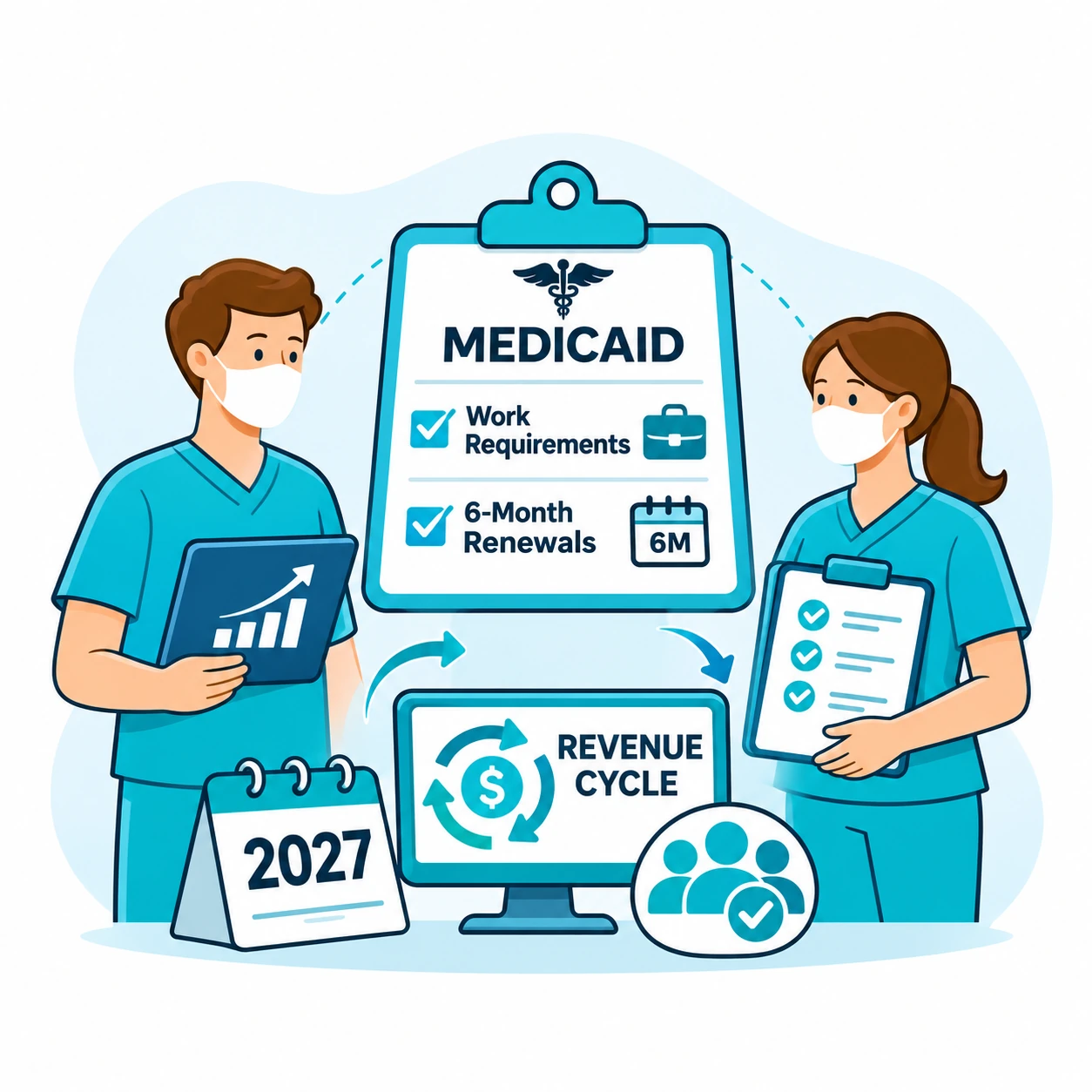
For many behavioral health organizations, Medicaid is the single largest payer. Starting in 2027, keeping patients on Medicaid gets harder. The 2025 federal budget law (Public Law 119-21) requires states to apply work and community engagement requirements to many Medicaid expansion adults and to renew their eligibility every six months instead of once a year.
When a patient loses coverage, the visit still happens. The payment does not. Eligibility is the first of the five reasons payers say no, which makes it a revenue issue for your agency, not just a social services issue.
What Changes in 2027
| Change | Who it applies to | Timing |
|---|---|---|
| Work or community engagement requirement (generally 80 hours a month of work, volunteering, school or job training) | Expansion adults ages 19 to 64, with exemptions | States must begin by January 1, 2027 (some may receive extensions) |
| Eligibility renewals every 6 months | Expansion adults | Renewals starting after December 31, 2026 |
CMS published an interim final rule in June 2026 to guide states. Exemptions include people who are medically frail, which covers individuals with a substance use disorder or a disabling mental disorder, as well as parents of young children and several other groups.
Why Behavioral Health Patients Are Most Exposed
Many adults with mental illness or substance use disorders qualify for Medicaid through expansion. Many also qualify for an exemption, but qualifying and proving it are different things. Missed mail, unstable housing and symptoms that make paperwork difficult are exactly the barriers that cause eligible people to lose coverage.
History shows the risk. When Arkansas ran a Medicaid work requirement in 2018, more than 18,000 people lost coverage in a matter of months, many of them because of reporting problems. In California, the Department of Health Care Services has estimated that over a million Medi-Cal members could lose coverage under the new requirements by the end of the decade.

What Coverage Loss Does to Your Revenue
Claims deny for eligibility, often weeks after the service, when the patient is hard to reach.
Programs keep treating patients without payment, increasing uncompensated care.
Gaps in coverage interrupt treatment, which affects outcomes, value-based metrics and county contract performance.
Six-month renewals double the number of eligibility checkpoints every year.
How to Build Eligibility Into Your Revenue Cycle
Verify more often
Run eligibility checks before every visit or at least monthly for every active Medicaid patient, not just at intake.
Store each patient's renewal date and flag patients 60 days before it.
Help patients prove exemptions
Document diagnoses, functional limitations and treatment participation clearly. States may need more than a diagnosis code to approve a medically frail exemption.
Train clinicians and care coordinators on what documentation the state requires and how to provide it quickly.
Make enrollment support a workflow
Assign staff to help patients complete renewals and report hours or exemptions.
Track terminations daily and re-enroll eligible patients before their next visit.
Measure eligibility denials, coverage gaps and recovered revenue every month.

Where Symed Fits
Symed, the Behavioral Health Division of Cosentus, runs on Smart RCM: Cosentus experts and Zeus Health, a Cosentus Division, working as one team. Zeus Health checks every claim before it goes out, and named expert teams handle every eligibility gap, authorization, denial and appeal. One partner covers billing, coding, eligibility, claims and even the EHR (optional), among other services, so no claim falls between vendors. Zeus Health runs nearly $1 Billion in claims annually, and Cosentus has served physicians since 1999.
One community behavioral care provider grew revenue 8x, from $1.2M in 2022 to a projected $10M in 2025. Individual results vary.
FAQs
The Bottom Line
In 2027, keeping eligible patients enrolled is part of getting paid. Behavioral health organizations that build eligibility checks and exemption support into everyday workflows will protect both their patients and their revenue.
Find out what coverage gaps are costing your agency. Know your numbers before you switch billing partners. Start with the No-Cost Financial MRI (Valued at $10,000): Symed checks every claim against the five reasons payers say no, and you keep a dollars-by-reason report and a 90-day action plan.


Sources
- Federal RegisterMedicaid Program; Community Engagement Requirement for Certain Individuals (CMS-2454-IFC), June 3, 2026federalregister.gov
- KFFImplications of Medicaid work and reporting requirements for adults with mental health or substance use disorderskff.org
- California Health Care FoundationHow the H.R. 1 work requirement will affect Californianschcf.org