

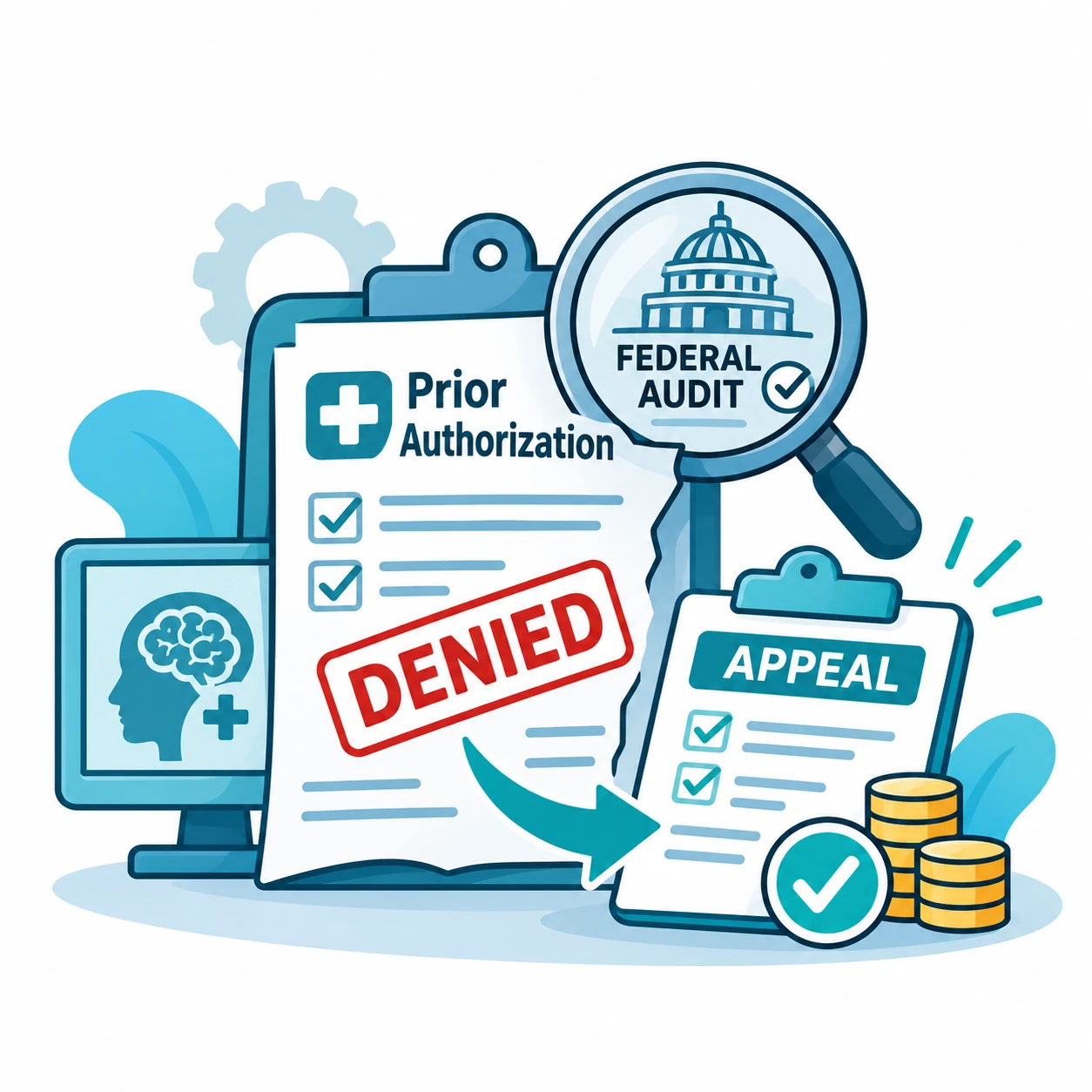
A denial no one fights stands, and the money for that care stays with the payer. Many behavioral health agencies still treat prior authorization denials from Medicaid managed care plans as a cost of doing business. A June 2026 federal audit suggests they should not.
What the Auditors Found
The HHS Office of Inspector General (OIG) audited Community Behavioral Health, a Pennsylvania behavioral health Medicaid managed care organization with the highest number of denied service requests in the state. It was the first OIG audit in its Medicaid managed care series to focus on behavioral health denials.
None of the 100 denied requests OIG sampled met all of the requirements for denying behavioral health services that needed prior authorization. OIG found:
Possible delays or denials of medically necessary services and appeals.
Denial notices sent to incorrect addresses.
Unclear denial notices.
State notice templates that did not tell enrollees they could request, free of charge, all records relevant to the denial.
This is not an isolated finding. In an earlier report, OIG found that Medicaid managed care plans denied about one in eight prior authorization requests, and many denials were never reviewed by an independent party.
Independent reviewers agree. In New York, 6 in 10 behavioral health denials sent to independent review were overturned (JAMA Internal Medicine, 2026). A denial no one fights stands. Symed fights every one.
New Federal Deadlines Work in Your Favor
Since January 1, 2026, the CMS Interoperability and Prior Authorization rule has required Medicaid managed care plans to decide standard requests within 7 calendar days and urgent requests within 72 hours, and to give a specific reason for every denial. By January 1, 2027, plans must support electronic prior authorization.
Specific denial reasons make it easier to see when a denial does not hold up. Missed deadlines give you grounds to escalate.
A Denial Response Playbook
| Step | What to do |
|---|---|
| 1. Log every denial | Track payer, service, level of care, denial reason, decision date and request date |
| 2. Check the notice | Confirm the plan met decision deadlines and gave a specific, clear reason and correct appeal rights |
| 3. Request the file | Ask for all documents and criteria used in the decision, which enrollees can request at no charge |
| 4. Fix and resubmit | If documentation was missing, resubmit quickly with the clinical evidence tied to the plan criteria |
| 5. Appeal | File internal appeals within the deadline, use peer-to-peer reviews and pursue state fair hearings when warranted |
| 6. Report patterns | Share denial trends with the plan, the county or state and your association |

Parity Still Matters
The payment gap is real. The four largest insurers pay 16 to 59% less for outpatient mental health care than for physical care, in every state (Mental Health Parity Index, April 2026).
Federal mental health parity law still requires plans to apply prior authorization and other limits to behavioral health no more strictly than to medical and surgical care. The federal agencies have paused enforcement of new provisions from the 2024 parity rule and plan to revisit it, but the underlying law and earlier regulations remain in effect. Denial data you collect today is the evidence for parity complaints tomorrow.
Where Symed Fits
Symed, the Behavioral Health Division of Cosentus, runs on Smart RCM: Cosentus experts and Zeus Health, a Cosentus Division, working as one team. Zeus Health checks every claim before it goes out, and named expert teams handle every eligibility gap, authorization, denial and appeal. One partner covers billing, coding, eligibility, claims and even the EHR (optional), among other services, so no claim falls between vendors. Zeus Health runs nearly $1 Billion in claims annually, and Cosentus has served physicians since 1999.
One community behavioral care provider grew revenue 8x, from $1.2M in 2022 to a projected $10M in 2025. Individual results vary.
FAQs
The Bottom Line
Prior authorization denials are not always right, and federal auditors have now shown it. Behavioral health organizations that log, check and appeal denials consistently will recover revenue and help patients get care faster.
Find out how many of your denials can still be won. Know your numbers before you switch billing partners. Start with the No-Cost Financial MRI (Valued at $10,000): Symed checks every claim against the five reasons payers say no, and you keep a dollars-by-reason report and a 90-day action plan.



Sources
- HHS OIGCommunity Behavioral Health Did Not Comply With Requirements When Denying Prior Authorization Requests (A-03-24-00204, June 2026)oig.hhs.gov
- KFFNew OIG report examines prior authorization denials in Medicaid MCOskff.org
- CMSInteroperability and Prior Authorization Final Rule (CMS-0057-F)cms.gov
- Behavioral Health Businessadministration to propose new parity rulebhbusiness.com
- JAMA Internal Medicine (2026)New York behavioral health denials overturned on independent review
- Mental Health Parity Index (April 2026)outpatient mental health paid 16 to 59% less than physical care