
Ambulatory surgery centers operate on thin margins and high volume, which makes billing accuracy less of a back-office detail and more of a survival skill. A surgery center that codes cleanly and captures every payable device and procedure runs a very different business than one that leaks revenue on each case.
This guide explains how ASC billing differs from physician billing, how the ASC payment system works, and where the biggest opportunities and risks live. Whether you handle billing internally or lean on a specialized ASC billing team like Cosentus, these are the fundamentals that protect your net collection rate.
Facility Billing vs Professional Billing
The first thing to understand about an ASC is that two separate claims usually come out of a single case. The facility claim covers the surgery center for the use of the room, staff, supplies, and equipment. The professional claim covers the surgeon and anesthesia provider for their personal services. These are billed on different claim forms and paid under different fee schedules.
Confusing the two is a frequent and expensive mistake. The facility is reimbursed under the ASC payment system for the encounter, while the physician is paid under the Physician Fee Schedule. Each has its own coding conventions, modifiers, and covered procedure lists, and each must be handled on its own terms.

How the ASC Payment System Works
Medicare pays ASCs only for procedures on its ASC covered procedures list, and each covered code carries a payment indicator that tells you how it is reimbursed. Some procedures are paid at a standard ASC rate, some are packaged, and some are device-intensive with special handling.
Commercial payers often follow a similar structure but negotiate their own rates and covered lists. The practical consequence is that a procedure profitable at one facility under one contract may be a loss at another. Surgery centers that model expected reimbursement by procedure and payer before scheduling avoid taking on cases that cost more to perform than they collect.
Device-Intensive Procedures and Implant Billing
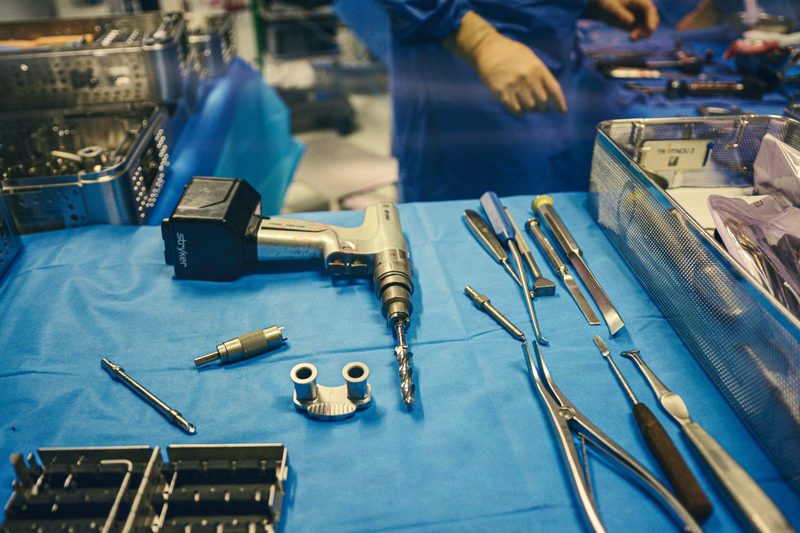
Device-intensive procedures are where ASC billing gets both lucrative and error-prone. These are procedures where the cost of an implanted device makes up a large share of the total, so the payment is structured to account for the device separately.
Implants and high-cost devices are typically reported with HCPCS Level II codes, often the C-codes used in the outpatient and ASC setting, and they must be documented with invoices and correct units. The most common failures are not reporting the device at all, reporting the wrong code, or missing the documentation a payer requires to reimburse it. On a device-intensive case, a single missed implant charge can wipe out the margin on the entire procedure.
Multiple-Procedure Discounting and Modifiers
When more than one procedure is performed in the same session, ASC payment applies multiple-procedure discounting. The highest-weighted procedure is generally paid at the full rate, and additional procedures are paid at a reduced rate, commonly 50 percent. This is expected and correct, but it means the order and coding of procedures affects total payment.
Modifiers do a lot of work on ASC claims. Modifier 50 reports bilateral procedures, modifier 59 and the X modifiers identify distinct procedures, and RT and LT indicate laterality. Historically the SG modifier identified ASC facility services, though its use has changed over time and by payer. Applying the right modifiers ensures each payable procedure is recognized rather than bundled away.
Clean Claims, Prior Authorization, and Net Collection
The healthiest surgery centers treat the front end as seriously as the operating room. Verifying benefits, securing prior authorization, and confirming that a procedure is covered and payable before the day of surgery prevents the denials that are hardest to fix afterward.
On the back end, clean claims, accurate device capture, correct modifiers, and disciplined denial follow-up drive the net collection rate. Small, consistent improvements across these areas compound quickly at ASC volumes. A partner running RCM 360 with surgery-center expertise, supported by analytics like Zeus AI, turns those gains into a measurable difference in monthly collections.
FAQs
The Bottom Line
ASC profitability is won on the margins, and billing is where many of those margins are decided. Getting the facility claim, the device capture, and the modifiers right on every case is not glamorous work, but it is what keeps a surgery center financially healthy.
Want to protect your surgery center margins? Schedule a no-cost financial review with Cosentus and see how your ASC collections compare to what they should be.